




Earn {{points}} for every {{amount}} you spend and turn them into discounts at checkout.
Join now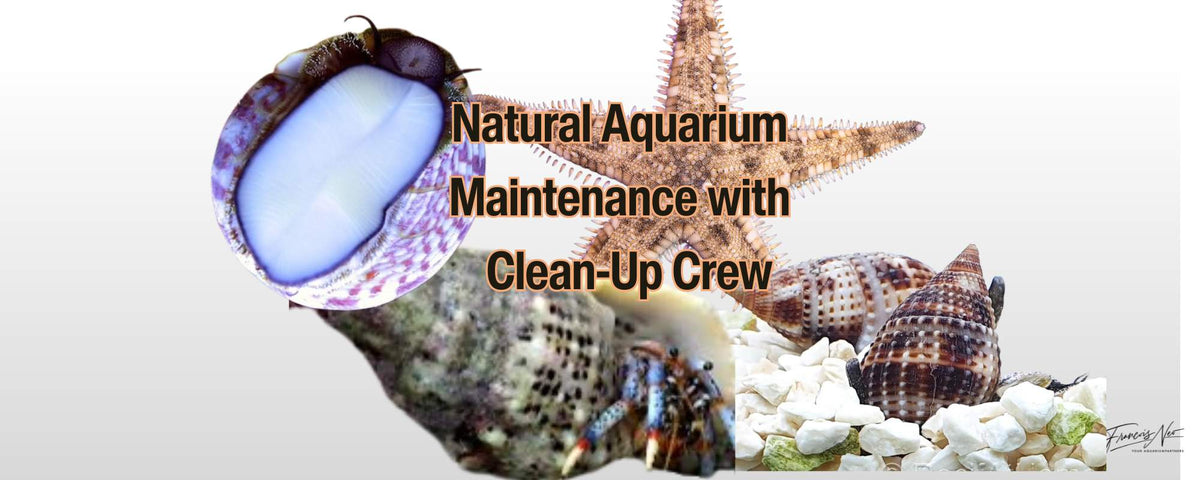
Natural Aquarium Maintenance with a Clean-Up Crew — The Francois Neo 20-Gallon Reef Kit
Natural Aquarium Maintenance with a Clean-Up Crew — The François Neo 20-Gallon Reef Kit
Introduction
In reef keeping, balance is everything.
You can have the best filtration, lights, and dosing systems — but nothing beats nature when it comes to long-term stability.
That’s where your clean-up crew (CUC) comes in — a natural team of tiny invertebrates that keeps your reef clean, your sand alive, and your rocks spotless.
As a European reefer living on the East Coast, I’ve always believed in natural maintenance first. My philosophy is simple: the best tanks are the ones that clean themselves — with the help of life itself.
And when it comes to the heart of that process, nothing beats the Blue-Leg Hermits. They’re small, hard-working, beautifully active, and always busy. Over the years, they’ve become my personal favorite — reliable little soldiers that turn chaos into harmony.
For general stocking, my natural rule of thumb is one clean-up crew member per gallon — adjusted slightly based on tank maturity, feeding habits, and nutrient load.
So in a 20-gallon AIO system, that’s roughly 15 to 20 total CUC members, distributed among hermits, snails, and other sand sifters for maximum balance.
This is the official Francois Neo Clean-Up Crew Kit (View the 20-gallon kit), crafted for hobbyists who believe in harmony between technology and biology.
Shop the Clean-Up Crew collection

Why Natural Maintenance Matters
Every reef system produces waste — uneaten food, algae growth, detritus.
If not managed, these lead to high nitrates, phosphates, and algae blooms.
Instead of relying only on skimmers and chemical media, a balanced CUC provides:
Biological cleaning: continuous grazing of algae and detritus
Sand oxygenation: movement and turnover of substrate
Nutrient recycling: food and organics are reused by the microfauna
Low-stress aesthetics: your reef stays naturally clean and active
The Core Team: What to Include in a 20-Gallon Reef
For a 20-gallon AIO system, you want diversity — but not chaos.
Each species has a specific ecological niche.
Together, they form a living ecosystem that maintains itself.
In my experience, a balanced 20-gallon setup follows a simple rule:
One CUC member per gallon — but distributed wisely among the different species listed below.
Blue-Leg Hermit Crabs (Clibanarius tricolor)
If you’ve followed me for a while, you already know — I’m a Blue-Leg guy.
They’re hardy, efficient, and full of personality. These little guys are constantly on patrol, eating leftover food, detritus, and microalgae.
-
Role: Algae grazers and scavengers — they clean your rocks, corners, and even the sand when hungry.
-
Behavior: Constant movement; always active and visible. They bring life to the display.
-
Benefit: Excellent for both beginners and advanced reefers; they adapt easily to most reef environments.
-
Pro tip: Provide several spare shells — they’ll fight for upgrades otherwise.
-
Recommended: 5 – 8 individuals for a 20-gallon reef.
💬 My personal take: If I had to choose only one species for natural maintenance, I’d take the Blue-Legs. They’re the backbone of every healthy, low-tech reef system.

Nassarius Snails (Nassarius vibex)
-
Role: Sand stirrers and organic waste consumers.
-
Behavior: They bury themselves under the sand and rise like “zombies” when they smell food.
-
Benefit: Keeps the sand bed oxygenated and clean, prevents hydrogen sulfide pockets.
-
Recommended: 3 – 5 individuals for a 20-gallon.

Sand-Sifting Starfish (Astropecten polycanthus or similar)
-
Role: Consumes micro-detritus, turns and refreshes the sand bed.
-
Important: Only introduce after 3–6 months — they need a mature, well-established sand bed to thrive.
-
Tip: Perfect addition for long-term stability in a 20–40 gallon tank.
-
Recommended: 1 individual per 20–40 gallons.
Trochus & Cerith Snails (Trochus sp., Cerithium sp.)
-
Role: Glass and rock cleaners — Trochus for the large areas, Ceriths for tight corners and overhangs.
-
Behavior: Day and night workers, highly efficient on film algae and detritus.
-
Recommended: 5–6 combined individuals for a 20-gallon.

Reef-Safe Urchins (Mespilia globulus, Tripneustes gratilla)
-
Role: Macroalgae grazers and coralline cleaners — perfect for keeping live rock healthy.
-
Behavior: Mostly nocturnal; they roam over rock structures and remove algae efficiently.
-
Tip: Choose small, reef-safe species like tuxedo or pincushion urchins.
-
Recommended: 1 per 20–30 gallons.
Putting It All Together
The François Neo 20-Gallon Reef Clean-Up Crew Kit
View the 20-Gallon AIO Reef Clean-Up Crew Kit
| Role | Species | Qty | Purpose |
|---|---|---|---|
| Algae control | Blue-Leg Hermit (Clibanarius tricolor) | 6 | Rock & corner cleaner |
| Sand stirring | Nassarius Snail (Nassarius vibex) | 4 | Waste and detritus control |
| Glass & rock cleaning | Trochus / Cerith Snails | 6 | Algae film removal |
| Sand rebalancing | Sand-Sifting Star (Astropecten sp.) | 1 | Sand micro-detritus removal |
| Heavy algae grazer | Tuxedo Urchin (Mespilia globulus) | 1 | Macroalgae & coralline control |
My pro-tip:
Add the crew in stages — start with snails and hermits, wait 3 weeks, then introduce sand sifters and urchin.
This allows your biofilm and bacterial foundation to establish naturally.
Maintenance Routine
-
Weekly: Spot-feed Nassarius with a small piece of frozen food or pellets.
-
Bi-weekly: Add extra shells for hermits.
-
Monthly: Inspect the sand — even, clean, no odor = healthy.
-
Every 2 months: Re-evaluate crew numbers — replace losses, avoid overstocking.
What You’ll Find in the François Neo Kits (Coming Soon on francoisneo.com)
1️⃣ Nano Reef Starter Kit (10 gal) (View kit) — Light, easy team for new hobbyists.
2️⃣ Mixed Reef Pack (15 gal) (Browse the Clean-Up Crew collection) — Adds Nassarius and Trochus variety.
3️⃣ AIO Reef Kit (20 gal) (View kit) — The “full ecosystem” approach with urchin and sand star.
Each kit comes with:
-
Acclimation instructions
-
Feeding & compatibility guide
-
QR link to a YouTube video tutorial
-
Optional add-on: “Reef Refresh” micro-food & extra shells
Market Inspiration (USA Pricing Reference, 2025)
| Store | Bundle | Price (USD) |
|---|---|---|
| SaltwaterAquarium.com | 25 Gallon Reef CUC | $59.99 |
| Top Shelf Aquatics | 30 Gallon CUC Invert Pack | $39.99 |
| World Wide Corals | Sand-Sifting Starfish | $24.99 |
| LiveAquaria | Nassarius Snail 10-Pack | $34.99 |
| Addictive Reefkeeping | Blue-Leg Hermit Bundle | $19.99 |
(Prices checked October 2025; see store listings for live availability.)
My Touch — “Nature First” Philosophy
I believe every aquarium deserves to run as close to nature as possible.
That’s why my clean-up kits are built around biological balance, low intervention, and species synergy — not just numbers.
Each bundle I release on francoisneo.com includes personal guidance, livestream setup support, and safe, temperature-controlled shipping — because every life matters.
Final Thoughts
A healthy clean-up crew is more than a collection of snails and crabs — it’s the invisible workforce that keeps your reef thriving.
In a 20-gallon AIO, the right mix of species — roughly one per gallon — transforms maintenance from a chore into a natural rhythm.
Start small, observe daily, and let nature handle the rest.
From reefers, for reefers — the Francois Neo way.